By Katarina Karac, Founding Attorney, Birchwood Law | Last reviewed September 2026
A code violation decision from Chicago’s Department of Administrative Hearings (DOAH), a suburban hearing officer, or a county hearing unit is appealed by filing a complaint for administrative review in circuit court under the Illinois Administrative Review Law (735 ILCS 5/3-101 et seq.). The complaint must be filed, and summons issued, within 35 days of the date the decision was served. The court decides the appeal on the hearing record. It does not retry the case or take new evidence.
This guide is for property owners, business owners, and their counsel deciding whether to challenge a liability finding, a fine, or a compliance order. Appeals of zoning board decisions follow different party and notice rules, which are covered in our guide to appealing a zoning decision in Chicago and the suburbs.
When a Code Violation Decision Becomes Appealable
Only a final decision can be appealed. Section 3-101 defines a final decision as one that affects legal rights and terminates the proceedings before the agency. An order continuing a DOAH case to a later compliance date is not final. A finding of liability with fines, or a final compliance order, is.
Two situations change the analysis:
- Default orders. If the case ended in default because no one appeared, the first step is usually a Motion to Set Aside at the hearing body. In Chicago, that motion is due within 21 days of the default order and requires a showing of illness or emergency (DOAH guide). A default leaves almost nothing in the record for a court to review, so vacating it at DOAH generally does more for the owner than going straight to court.
- Rehearing rules. Where a hearing body’s rules allow a rehearing request within a fixed period and one is filed, Section 3-101 postpones finality until that request is decided. Check the local ordinance before assuming the 35 days is already running.
The 35-Day Administrative Review Deadline
Section 3-103 requires two things within 35 days of service of the decision: the complaint must be filed, and summons must be issued. Filing alone does not satisfy the statute. Illinois courts have dismissed administrative review actions where the complaint was timely but summons was not issued against every required defendant within the period (appellate decision applying Sections 3-103 and 3-105).
The clock starts on service, not receipt. Unless the governing ordinance says otherwise, a decision is served when it is personally delivered or deposited in the mail. For mailed DOAH decisions, the mailing date controls (Illinois Legal Aid Online).
In computing the period, the first day is excluded and the last day is included. Intervening weekends count. Only a final day that falls on a weekend or court holiday moves to the next business day (ISBA administrative review checklist).
A missed deadline is generally fatal. Section 3-102 bars judicial review of any decision not challenged within the time, and in the manner, the statute requires.
Where to File a Code Violation Appeal
City of Chicago (DOAH)
DOAH decisions are reviewed in the Circuit Court of Cook County at the Daley Center. The city’s own guidance confirms that either side may seek review within 35 days (DOAH: Appealing a Decision). Review of DOAH cases has been assigned to the First Municipal District, Civil Division (ISBA summary of Cook County assignments).
Filing is electronic. The standard package includes:
- An administrative review cover sheet.
- The Complaint for Illinois Administrative Review.
- A Summons in Administrative Review.
- A copy of the Findings, Decisions and Order issued at the hearing.
The clerk’s current fee schedule applies.
Suburban Cook County Municipalities
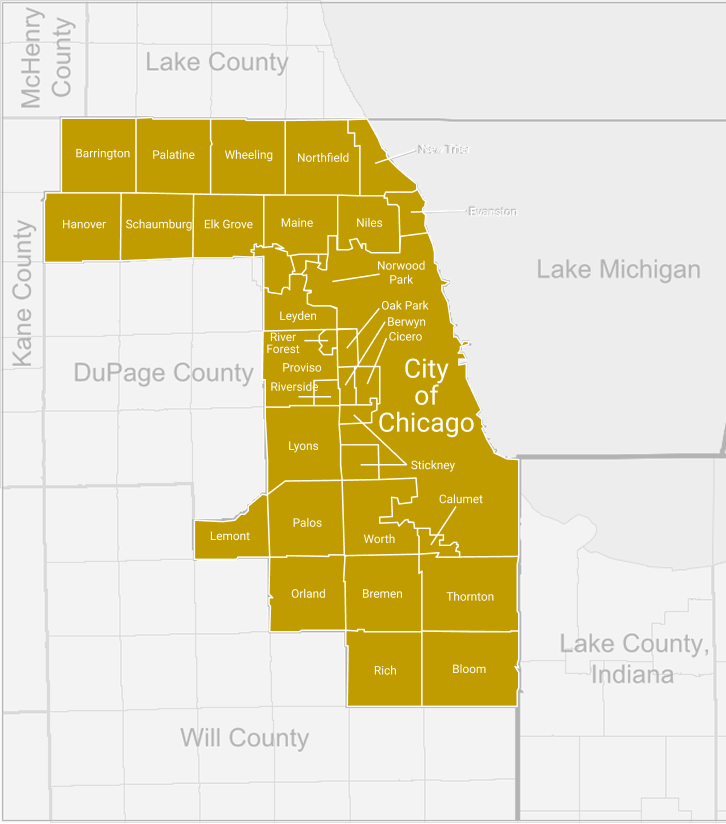
Review of a suburban code hearing unit’s decision is heard in the Cook County municipal district where that municipality is located (Circuit Court of Cook County General Orders).
Lake County, DuPage County, and Unincorporated Areas
Where no statute sets venue, Section 3-104 permits filing in the circuit court of any county where the hearing was held, where the property is located, or where the underlying events occurred. For property in Lake County that is ordinarily the Nineteenth Judicial Circuit, and for DuPage County the Eighteenth Judicial Circuit.
The typical timeframe from the filing of the complaint to the decision can vary, with most cases getting resolved between four month to one year, depending on the issues at hand.
Naming Defendants and Serving Summons
Section 3-107 requires the complaint to name the agency and every other party of record in the hearing below. In a Chicago building case, the Cook County form names DOAH. The City, which prosecutes the case, will ordinarily also be a party of record, so check the caption of the hearing record before filing.
Naming the agency head in an official capacity counts as naming the agency. A misnomer does not defeat jurisdiction if the correct party was served with timely summons.
If the court finds a required party was omitted, it must give the plaintiff 35 days to name and serve that party. That safety valve does not cure a failure to have summons issued at all within the original 35 days.
Under Section 3-105, the clerk serves summons by certified or registered mail. The plaintiff must file an affidavit designating each defendant’s last known address.
What the Court Reviews on Appeal
Review is confined to the administrative record. Section 3-110 bars new or additional evidence and treats the agency’s factual findings as prima facie true and correct.
The Illinois Supreme Court applies one of three standards depending on the question presented (City of Belvidere v. Illinois State Labor Relations Board, 181 Ill. 2d 191 (1998); AFM Messenger Service v. Department of Employment Security, 198 Ill. 2d 380 (2001)):
- Questions of fact are reviewed for whether the finding is against the manifest weight of the evidence, meaning the opposite conclusion is clearly evident.
- Questions of law are reviewed de novo, with no deference to the hearing officer.
- Mixed questions, where the facts are settled and the issue is whether they satisfy the legal standard, are reviewed for clear error. The court reverses only if it is left with a definite and firm conviction that a mistake was made.
Section 3-111(b) adds that technical errors, or departures from the rules of evidence, are not grounds for reversal unless they materially affected a party’s rights and caused substantial injustice.
Arguments That Hold Up on Review
In code violation cases, the strongest arguments on review tend to be legal or mixed questions tied to the Municipal Code itself:
- The cited provision does not apply to the property’s use, occupancy classification, or construction type.
- The penalty exceeds what the ordinance authorizes. This includes a fine outside the cited section’s range, or one above DOAH’s $50,000 cap on fines, which excludes enforcement and compliance costs (Chicago Municipal Code 2-14-076).
- A recognized defense was wrongly rejected. For example, the record shows the violation was remedied before the hearing under Section 2-14-155(b).
- Notice or service did not meet Section 2-14-152.
- The respondent is not an “owner” as Section 2-14-151 defines the term for building cases.
A disagreement with what the inspector observed is a factual challenge. It faces the manifest weight standard and rarely succeeds unless the record itself contradicts the finding.
Building the Record at the Hearing
Because the court cannot consider new evidence, the appeal is largely won or lost at DOAH. Anything the owner wants the court to see has to be offered at the hearing so it appears in the record. That includes issued permits, contractor and architect letters, dated photographs, reinspection requests, and objections to the city’s evidence.
If correction is already underway when liability is found, the officer may set a separate hearing on fines within 30 days and order a reinspection first (Section 2-14-156). Requesting that hearing preserves the chance to document compliance before penalties are fixed.
The record usually consists of the exhibits, notices of violation, the Findings and the Decision. It’s important to present evidence at every administrative hearing as if it will be challenged in circuit court, so Birchwood Law attorneys typically make sure to also enter as exhibits photographs of the condition of the property, written objections to the interpretation of the law or the factual record, expert reports, public records favoring the client, and other evidence that may be helpful to the client’s case.
Stays: Fines and Orders While the Appeal Is Pending
Filing for review does not suspend the decision. Under Section 3-111(a)(1), the court may stay it, with or without bond, only on a showing of good cause. Good cause has three parts:
- A stay is needed to preserve the status quo without endangering the public.
- The stay is not contrary to public policy.
- There is a reasonable likelihood of success on the merits.
The first element is difficult to meet when the underlying violation involves exits, fire separation, smoke or carbon monoxide detectors, or other life-safety conditions.
Without a stay, a DOAH judgment remains enforceable in the same way as a court judgment. Failing to comply with a DOAH order is also separately punishable in court (Chicago Municipal Code 2-14-100).
Possible Outcomes on Review
Under Section 3-111, the circuit court may affirm, reverse in whole or in part, or reverse and remand with instructions. A remand to take additional evidence is limited to evidence that is material, not cumulative, and could not have been obtained at the original hearing with reasonable diligence. Either side may appeal the circuit court’s judgment to the Appellate Court under Section 3-112.
Deciding Whether to Seek Review
Administrative review makes sense in three situations:
- The decision rests on a legal error that affects the property’s use or value.
- A compliance order requires work the code does not demand.
- The ruling could be applied to other properties the owner holds.
Where the dispute is really about whether a use is permitted, a zoning remedy may resolve the problem more durably than a court reversal. That could be a special use permit, a variation, or a map amendment.
Where the violation is correctable, compliance is often faster. The city can nonsuit a DOAH case when the owner provides timely proof of repair (Department of Buildings enforcement process). Fines, meanwhile, continue to accrue while an unstayed appeal is pending.
At Birchwood Law, we strive to help the client resolve code-related disputes with the least amount of economic harm to them. Oftentimes, we try to work out an agreement with opposing counsel to hold off on fines and allow our client to remedy the violation. If fines have already been assessed, we try to vacate or reduce them, depending on the circumstance. On rare occasion, we pursue an administrative appeal, especially when both the law and the facts favor the client, and we’re not able to resolve the situation amicably with the municipality.
Talk to Birchwood Law About an Adverse Decision
Birchwood Law represents business owners and property owners in administrative review of code violation and zoning decisions in Cook, Lake, and DuPage Counties. We also handle the underlying hearings where the record is built. See our administrative appeals practice and zoning litigation pages, and for the hearing stage, read how code violation hearings work in Illinois.
The 35-day period begins when the decision is served. Contact Birchwood Law with the Findings, Decisions and Order in hand.
This article provides general information about Illinois law and is not legal advice. Reading it does not create an attorney-client relationship.
Author Bio

Katarina Karac
Katarina is a Chicagoland zoning attorney with a deep understanding of how planning staff and local officials approach land use decisions, thanks to her prior work representing public development agencies. She now uses that experience to help private clients move projects through the approval process with focus and efficiency.
She has guided residential, commercial, mixed-use, and industrial developments from concept to approval, appearing before boards, commissions, and neighborhood groups. Known for her clear communication and high success rate, Katarina also regularly presents on zoning and land use at legal seminars and CLEs.


Legal Team


Speed