By Katarina Karac, Founding Attorney | Last reviewed October 2026
Where code violation hearings are held depends on who issued the violation and how serious the issuing body considers it. In Chicago, the Department of Buildings assigns every building code violation an enforcement level:
- Maintenance items receive a warning notice.
- Life-safety violations that are not dangerous or hazardous are prosecuted at the Department of Administrative Hearings (DOAH).
- Dangerous and hazardous conditions are filed in the Circuit Court of Cook County.
Suburban violations go to a municipal hearing officer or the county circuit court. Violations in unincorporated areas are heard by the county.
The venue determines who decides the case, which penalties are available, how quickly it moves, and how it is appealed. The sections below cover each system in Cook, Lake, and DuPage Counties.
Chicago’s Notice Levels: 20, 50, and 80
The Department of Buildings’ published enforcement process sorts violations into three tracks:
- 20 notice: maintenance violations. This is a warning notice.
- 50 notice: life-safety violations that are not dangerous or hazardous. These cases go to DOAH.
- 80 notice: dangerous and hazardous life-safety violations. These cases go to circuit court.
Before any case is filed, the Department of Law runs title to identify the responsible owner. Title work in administrative cases typically covers the legal title holder and parties in possession or control. Circuit court title work is broader and reaches mortgage holders, lienholders, and other recorded interests.
If no living owner can be identified in an administrative case, it is automatically moved to circuit court.
What Happens at DOAH’s Buildings Hearings Division
DOAH’s Buildings Hearings Division hears cases brought by the Buildings, Fire, and Zoning Departments. That includes structural, plumbing, and electrical violations, illegal construction and conversions done without permits, billboard violations, and fire code violations such as insufficient exits. Hearings are held at the Central Hearing Facility, 400 West Superior Street. The Illinois Appellate Court has described that facility as rivaling county courthouses in size and case volume (ISBA summary of Stone Street Partners v. City of Chicago).
An administrative hearing is civil. The city must prove the violation by a preponderance of the evidence, and the administrative law officer cannot impose jail time (DOAH guide).
Chapter 2-14, Article III of the Municipal Code sets the ground rules for building cases (Article III text):
- Timing. In non-emergency cases, the hearing cannot be set sooner than 30 days after the inspector reports the violation (Section 2-14-152).
- Service. Notice may be served personally, by mail to the owner’s registered agent, or by mail to the owner’s residence or business. If those methods fail, notice may be posted on the building’s front entrance at least 20 days before the hearing.
- Defenses (Section 2-14-155):
- The violation did not exist at the time of inspection.
- It was remedied by the hearing date. For Sections 13-196-400 through 13-196-440, the remedy must occur within seven days of service.
- Occupants caused it despite the owner’s reasonable efforts.
- An occupant refused the owner access to make the repair.
- Separate fine hearing. If the owner is found liable but has begun correcting the violation, the officer may set a separate hearing on fines within 30 days and order a reinspection first (Section 2-14-156).
A DOAH building case closes with a finding of liable or not liable, a nonsuit, a default, or a dismissal. The Department of Buildings lists timely proof of repair as one basis on which the city nonsuits a case. A case is continued as many times as needed for repairs and permits to move forward, which is why most DOAH building cases involve several hearing dates.
In our experience, when trust is established with counsel for the City, and a plan of action is put forth and agreed upon by the parties, the cases usually end up with lower fines and are resolve in a shorter amount of time compared to situations where there is no trust between the parties or a clear plan of action.
Circuit Court Building Cases
Dangerous and hazardous conditions go to the Circuit Court of Cook County, where the city has enforcement tools DOAH lacks. According to the Department of Buildings:
- At the first court date, city prosecutors prioritize missing smoke and carbon monoxide detectors and ask for an abatement order requiring compliance within 24 to 48 hours.
- A Department of Buildings court inspector reinspects the building before every hearing and recommends repairs for the court’s order.
- Once dangerous conditions are abated, the city may agree to dismiss the case subject to a consent decree that gives the owner more time for remaining items.
- If the owner will not or cannot abate dangerous conditions, the court may appoint a receiver. If a receivership is not feasible, the court may order the building vacated. A vacated building can be transferred to the demolition court call.
The $50,000 limit on administrative fines in Section 2-14-076 applies to DOAH administrative law officers, not to circuit court judges.
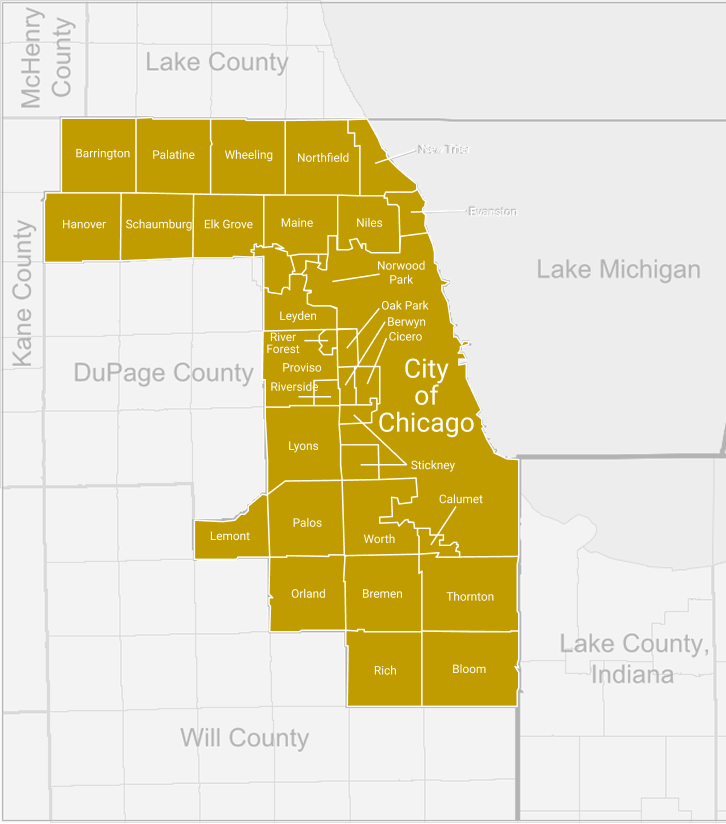
Code Violation Hearings in Suburban Cook, Lake, and DuPage Counties
Many suburbs operate administrative adjudication systems for building, zoning, and property maintenance violations. Wheaton hears zoning, building, and fire code cases before an independent hearing officer at City Hall on the second Wednesday of each month. Burr Ridge opened its adjudication court in 2021 to hear ordinance violations that previously went to the Cook or DuPage County circuit courts.
In towns without a system, and for cases a town chooses to file in court, violations are prosecuted in the circuit court of the county.
Penalty limits depend on home-rule status. For non-home-rule municipalities, the Illinois Municipal Code caps ordinance fines at $750 per offense (65 ILCS 5/1-2-1). Many local ordinances define each day of a continuing violation as a separate offense, which produces the “up to $750 per day” language common on suburban notices. Home-rule municipalities are not bound by that cap and set their own penalties. That group includes Chicago and most municipalities with more than 25,000 residents.
Amongst the municipalities in Lake, Cook, and DuPage County, the approach to code enforcement varies quite broadly. Some municipalities, like Wood Dale, have an aggressive approach to daily fines and regularly pursue judgments, while other municipalities, like Evanston, use a formula for calculating fines that takes into account the number of offenses.
Unincorporated Areas: County Hearing Systems
Outside municipal limits, the county enforces its own ordinances:
- Cook County adjudicates violations through its Department of Administrative Hearings.
- Lake and DuPage Counties are among the collar counties authorized by 2010 state legislation to adopt administrative adjudication. Lake County’s Planning, Building and Development Department enforces zoning, building, and property maintenance codes in unincorporated areas (Lake County code enforcement), and its administrative adjudication program hears ordinance violations.
Building Code Violation Fines in Chicago
Under the Chicago Construction Codes, each violation and each day it continues is a separate offense. Amounts are set by violation type in the Section 14A-12-1203 fine tables.
At DOAH, the administrative law officer may impose fines, issue compliance orders, and assess costs. Total fines are capped at $50,000, not counting enforcement and compliance costs.
A DOAH order that is ignored becomes its own offense. Violating an administrative order can bring a fine of $200 to $500 per offense, up to 180 days of incarceration, or community service, in a case the city brings in circuit court (Section 2-14-100).
Unpaid administrative judgments are enforceable like court judgments. Current balances can be viewed and paid through the city’s administrative hearing fines portal.
What a City of Chicago Notice of Violation Means
A notice of violation is the city’s formal statement that an inspector found one or more code violations at the property. How serious it is depends on which document arrived:
- A 20-level warning notice identifies maintenance items before any case is filed.
- A notice of hearing with a DOAH docket number means an administrative case is pending, with a hearing date at least 30 days out.
- A summons means the city has filed in circuit court.
Missed Hearings and Defaults
If no one appears, the administrative law officer enters a default. In Chicago, an owner who missed the hearing because of illness or an emergency has 21 days from the date on the default order to file a Motion to Set Aside. After a default and fine, the Department of Buildings may ask for a new complaint if dangerous or hazardous conditions remain.
Appealing a Hearing Decision
Final administrative decisions are reviewed in circuit court under the Illinois Administrative Review Law. The complaint must be filed, and summons issued, within 35 days of service of the decision, and the court reviews only the hearing record. Our guide to appealing a code violation decision in Illinois covers the deadline, venue, standards of review, and stays in detail.
Preparing for a Code Violation Hearing
Because review on appeal is limited to the hearing record, preparation should assume the hearing is the only chance to put evidence before a decision-maker:
- Confirm the venue and docket number, and find out whether the case is a 50-level DOAH matter or an 80-level circuit court case.
- Pull the property’s permit and inspection history from the city’s building records search.
- Begin corrections under permit. Unpermitted repairs can generate new violations.
- Assemble dated photographs, issued permits, and contractor or architect letters for the record.
- If a use or zoning question drives the violation, evaluate zoning relief in parallel.
For related guidance, see what to do after receiving a zoning violation notice and getting ahead of municipal fines.
Representation in Code Violation Hearings
Birchwood Law represents business owners and property owners before DOAH, suburban hearing officers, and circuit courts across Cook, Lake, and DuPage Counties. The team includes Melissa Klotz, former Evanston Zoning Administrator, who worked on the municipal side of zoning administration before joining the firm in a non-attorney support role. The firm also provides interpreter services at no cost.
See our land use and zoning services, or contact Birchwood Law before the first hearing date.
This article provides general information about Illinois law and is not legal advice. Reading it does not create an attorney-client relationship.
Author Bio

Katarina Karac
Katarina is a Chicagoland zoning attorney with a deep understanding of how planning staff and local officials approach land use decisions, thanks to her prior work representing public development agencies. She now uses that experience to help private clients move projects through the approval process with focus and efficiency.
She has guided residential, commercial, mixed-use, and industrial developments from concept to approval, appearing before boards, commissions, and neighborhood groups. Known for her clear communication and high success rate, Katarina also regularly presents on zoning and land use at legal seminars and CLEs.


Legal Team


Speed